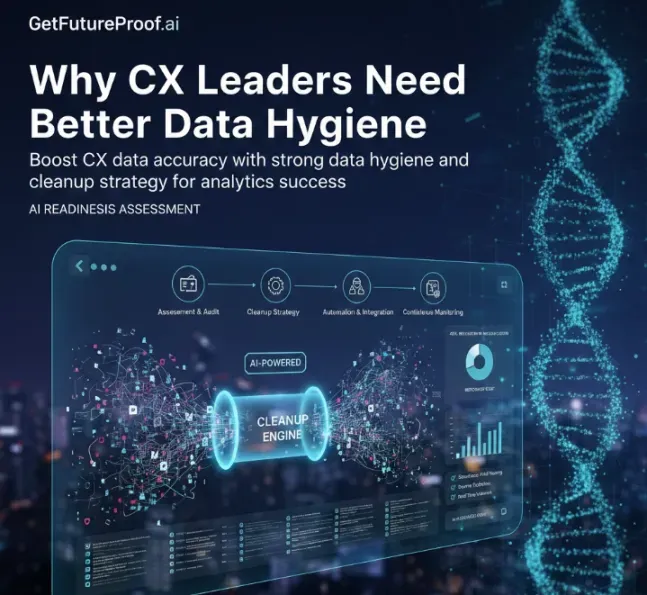
Why CX Leaders Need Better Data Hygiene
Introduction
Customer experience (CX) leaders often rely on data to guide strategic decisions, yet many organizations struggle with messy, inconsistent, or outdated information. Poor data hygiene leads to misaligned insights, inefficiencies, and suboptimal customer interactions. Investing in strong data hygiene isn’t just IT housekeeping—it’s a critical enabler for actionable analytics, operational efficiency, and AI readiness.
The 4-Stage CX Data Hygiene Framework
To improve CX data quality, adopt a structured approach:
Stage 1: Assessment & Audit
Identify all CX data sources (CRM, support tickets, surveys, chat logs)
Evaluate completeness, consistency, and accuracy
Flag duplicates, outdated records, and inconsistent tagging
Stage 2: Cleanup Strategy
Standardize data fields, naming conventions, and tags
Remove duplicates and obsolete entries
Ensure compliance with privacy regulations (e.g., GDPR, CCPA)
Stage 3: Automation & Integration
Use AI-assisted tools to automatically detect errors and inconsistencies
Integrate data streams to unify CX insights across channels
Apply real-time validation for incoming data
Stage 4: Continuous Monitoring
Establish KPIs for data accuracy, completeness, and freshness
Schedule regular audits and feedback loops
Train staff on maintaining data hygiene best practices
Key Metrics & Signals of CX Data Readiness
Percentage of complete records in CRM and CX systems
Consistency of tagging across all channels
Error rates in automated reports and dashboards
Timeliness of data refresh and updates
Best Practices for Cost-Optimized Data Hygiene
Prioritize high-impact data sources that influence revenue and retention
Automate repetitive cleanup tasks to reduce manual effort
Leverage cloud-based platforms for scalable and cost-effective storage
Align data hygiene efforts with AI-readiness initiatives to maximize ROI
Real-World Example: What to Avoid
A mid-sized SaaS company neglected customer tagging consistency across support tickets, leading to misrouted queries and delayed response times. After implementing a structured cleanup strategy and AI-assisted monitoring, the team reduced ticket misclassification by 40% and improved CSAT scores significantly.
Quick Wins Checklist for CX Leaders
Action Expected Outcome Audit top 3 CX data sources Identify critical gaps Standardize field naming & tags Reduce inconsistency Remove duplicates Improve reporting accuracy Implement real-time validation Maintain ongoing hygiene Automate repetitive tasks Lower operational cost
FAQs
1. What is an AI readiness assessment and why does it matter?
It evaluates whether your organization’s data and processes are prepared for AI adoption, ensuring smoother automation and actionable insights. Take our AI-readiness quiz.
2. How can I cut operational costs before investing in AI?
Streamline workflows, improve data quality, and leverage automation tools. Download our cost-cutting toolkit for step-by-step guidance.
3. What are the biggest blockers to digital transformation in enterprise?
Poor data quality, siloed systems, lack of governance, and outdated processes.
4. How do I future-proof my operations for the next 5 years?
Invest in scalable cloud platforms, enforce data governance, and continuously train your workforce.
5. When should I use a tool like GetFutureProof.ai vs building in-house?
Use our tools for faster assessment, cost optimization, and structured AI-readiness roadmaps without overburdening internal teams.
Conclusion
Ready to evaluate your organization’s CX data hygiene and build a future-proof strategy? Explore GetFutureProof.ai’s assessment tools to get started.3


