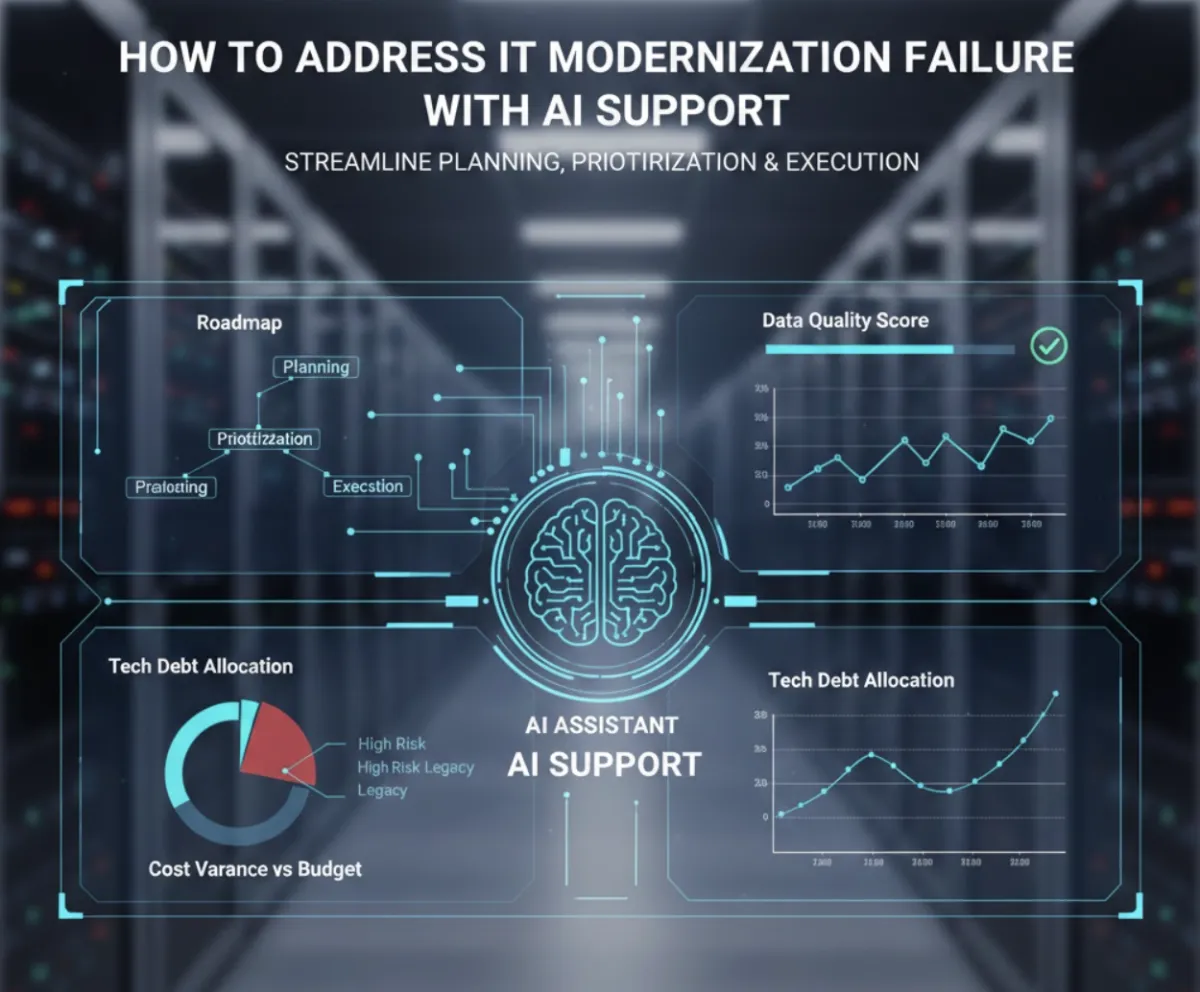
Why IT Modernization Fails (and How AI Fixes It)
Introduction
Many enterprises invest heavily in IT modernization, only to see initiatives stall, costs spike, and operational benefits delayed. Common challenges—ranging from unclear roadmaps to legacy tech debt—create high failure rates. Understanding these pitfalls is the first step to ensuring your IT transformation succeeds.
Common Causes of IT Modernization Failure
1. Lack of a Clear Roadmap
Without a structured plan, modernization efforts often drift, creating confusion among IT teams and business stakeholders.
2. Poor Data Quality
Legacy systems often contain incomplete or inconsistent data, which hinders migration, analytics, and automation initiatives.
3. Undefined Ownership
When responsibilities are unclear, projects stall, accountability is lost, and decisions are delayed.
4. Accumulated Tech Debt
A buildup of outdated or unsupported systems increases complexity and risk, making transformation more difficult and costly.
How AI Supports IT Modernization
1. Intelligent Planning
AI-driven analytics can identify system interdependencies, map technology lifecycles, and highlight high-impact modernization opportunities.
2. Prioritization with Precision
Machine learning algorithms assess risk, cost, and business value across IT assets, helping leaders focus on initiatives that deliver maximum ROI.
3. Accelerated Execution
AI tools automate testing, code analysis, and migration validation, reducing errors and speeding up project timelines.
4. Continuous Monitoring
AI-powered dashboards track modernization progress in real time, alerting teams to bottlenecks or emerging risks.
Key Metrics for AI-Enhanced Modernization
Metric Why It Matters System uptime post-migration Measures operational resilience Cost variance vs budget Indicates financial control Project completion rate Tracks adherence to roadmap Data quality score Ensures analytics reliability
Quick Wins Checklist
Conduct a tech debt inventory
Prioritize high-impact systems with AI insights
Automate code and migration validation
Monitor KPIs in real time
Engage business owners early to assign ownership
Real Example: Avoiding Pitfalls
A mid-sized enterprise began a cloud migration without mapping system dependencies. Unexpected conflicts delayed deployment by six months. By integrating AI-based analysis, the team quickly identified dependencies, reprioritized tasks, and completed migration efficiently, avoiding further cost overruns.
FAQ
What is an AI readiness assessment and why does it matter?
It evaluates your organization’s capacity to adopt AI-driven modernization, highlighting gaps in processes, data, and infrastructure.
How can I cut operational costs before IT modernization?
Leverage AI analytics to identify low-value systems, automate repetitive tasks, and consolidate redundant applications.
What are the biggest blockers to IT transformation?
Common blockers include unclear roadmaps, tech debt, poor data quality, and undefined ownership.
How do I future-proof my operations for the next 5 years?
Implement AI-driven monitoring, standardize IT processes, and prioritize modular, cloud-friendly systems.
When should I use a tool like GetFutureProof.ai vs building in-house?
Use our assessment tools for rapid insights and benchmarking, while internal teams focus on implementation and organizational change.
Conclusion
Ready to reduce IT modernization failure and accelerate transformation with AI? Explore GetFutureProof.ai’s assessment tools to get started.


