What Is a Self-Service CX Strategy?
Many enterprises invest heavily in customer support only to find response times lagging and costs rising. A self-service CX strategy can bridge this gap, enabling customers to resolve issues quickly while reducing operational load.
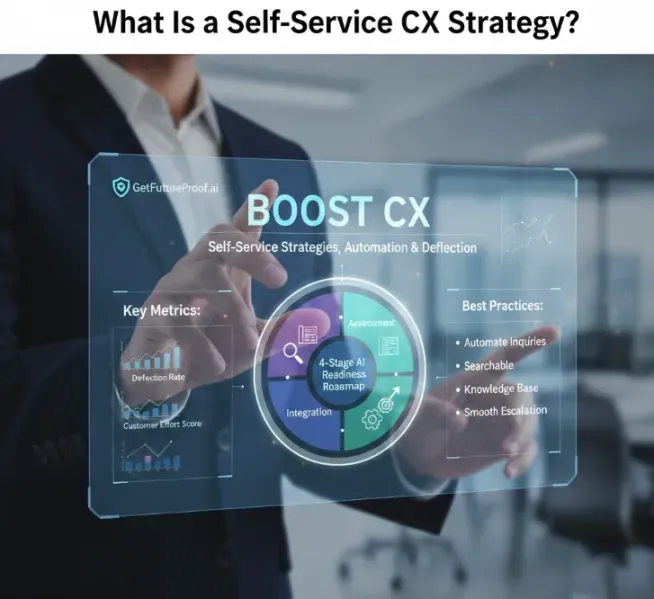
4-Stage AI Readiness Roadmap for Self-Service
Implementing a successful self-service strategy requires a structured approach:
Assessment: Audit existing support channels to identify common queries, bottlenecks, and customer pain points. Tools like GetFutureProof.ai’s AI Readiness Toolkit can help measure current capabilities.
Design: Map knowledge bases, FAQ automation, chatbots, and guided flows. Focus on usability, consistent tone, and seamless handoffs to agents when needed.
Integration: Embed automation into existing CRM and CX platforms, ensuring data flows are consistent and actionable.
Optimization: Continuously track metrics like deflection rates, resolution time, and CSAT scores to refine the self-service experience.
Key Metrics for Self-Service Readiness
Deflection Rate: Percentage of issues resolved without agent intervention.
Customer Effort Score (CES): How easy is it for users to resolve their issues?
Knowledge Base Usage: Frequency and effectiveness of content accessed by customers.
AI Accuracy: Chatbot response relevance and correct escalation.
Best Practices for Cost-Optimized Self-Service
Leverage AI to automate repetitive inquiries.
Maintain a clean, tagged, and searchable knowledge base.
Enable smooth escalation paths to live agents.
Use analytics to spot gaps and continuously improve content.
Example: What to Avoid
A large enterprise deployed chatbots without analyzing common customer questions. Most bots failed to provide accurate guidance, resulting in higher call volumes and frustrated users. Lesson: a well-planned, AI-assisted knowledge base is essential.
Quick Wins Checklist
Action Benefit Audit top 50 support queries Identify high-impact automation opportunities Implement guided FAQ flows Reduce repeat tickets Integrate chatbots with CRM Ensure context-rich responses Track deflection & CSAT Measure impact and optimize Schedule quarterly content reviews Maintain accuracy and relevance
FAQ
Q: What is an AI readiness assessment and why does it matter?
A: It evaluates your organization's capability to deploy AI-driven self-service, helping prioritize investments and reduce risks. Take our AI Readiness Quiz to benchmark your readiness.
Q: How can I cut operational costs before investing in AI?
A: Streamline processes, optimize staffing, and clean up knowledge content to maximize the impact of future automation.
Q: What are the biggest blockers to digital transformation in enterprise?
A: Siloed data, outdated processes, low employee adoption, and unclear strategic alignment.
Q: How do I future-proof my operations for the next 5 years?
A: Adopt scalable AI solutions, continuously train staff, and establish metrics for monitoring adoption and performance.
Q: When should I use a tool like GetFutureProof.ai vs building in-house?
A: Use a platform like GetFutureProof.ai for assessment, benchmarking, and structured guidance—especially if in-house resources or expertise are limited.
Conclusion
Ready to evaluate your organization’s AI readiness and implement a self-service CX strategy? Explore GetFutureProof.ai’s assessment tools to get started.


