What Is Real-Time Call Analytics?
Introduction
Many enterprises invest heavily in contact center technology but struggle to translate raw data into actionable insights. Costs balloon, agent performance varies, and customer satisfaction lags. Real-time call analytics can change that by providing instant visibility into every interaction, enabling smarter coaching, routing, and operational decisions.
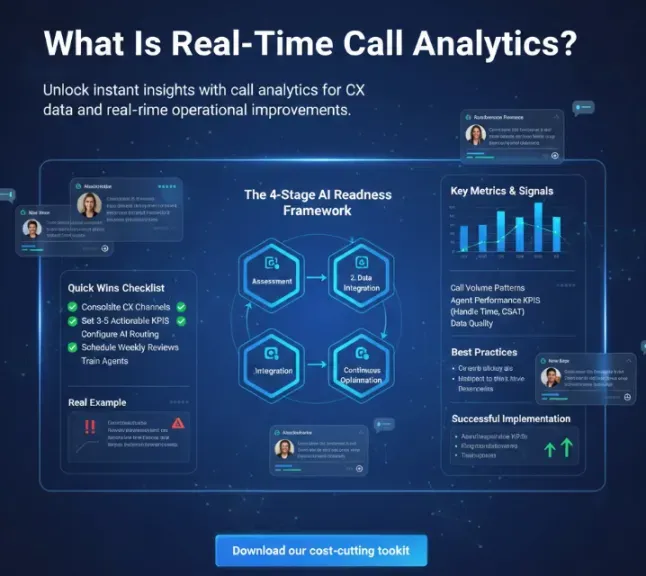
The 4-Stage AI Readiness Framework for Call Analytics
Implementing real-time call analytics requires a structured approach to ensure ROI and operational efficiency.
Stage Focus Key Activities 1 Assessment Take our AI-readiness quiz to gauge current capabilities and CX data maturity. 2 Data Integration Consolidate call, chat, and email channels into a unified dashboard. 3 Analytics Deployment Configure real-time KPIs, coaching triggers, and routing adjustments. 4 Continuous Optimization Use dashboards for ongoing monitoring, AI-driven predictions, and process improvements.
Key Metrics and Signals for Readiness
To determine if your contact center is ready for real-time call analytics, track:
Call volume patterns: Identify peaks and bottlenecks.
Agent performance KPIs: Handle time, resolution rate, and CSAT.
Data quality: Accuracy of call metadata and CRM integration.
Current automation level: Existing AI or routing technologies in use.
Best Practices for Cost-Optimizing Operations
Before scaling real-time analytics:
Prioritize channels with the highest customer impact.
Implement automated dashboards to reduce manual reporting.
Start with pilot teams to refine KPIs and coaching triggers.
Leverage AI-driven insights to optimize agent allocation and routing.
Download our cost-cutting toolkit to identify quick wins.
Real Example: What to Avoid
A large enterprise rolled out a real-time call analytics solution across all teams simultaneously. Without piloting, dashboards were underused, data inconsistencies emerged, and coaching was inconsistent. By contrast, teams that started small and refined metrics first achieved higher adoption and measurable CX improvements.
Quick Wins Checklist
Consolidate all CX channels into a unified dashboard.
Set 3–5 actionable KPIs per team.
Configure AI-driven routing triggers for high-value customers.
Schedule weekly review meetings using dashboard insights.
Train agents on interpreting real-time metrics for self-improvement.
FAQ
Q1: What is an AI readiness assessment and why does it matter?
A: It evaluates your current systems, data quality, and processes to ensure you can effectively deploy AI solutions like real-time call analytics.
Q2: How can I cut operational costs before investing in AI?
A: Identify redundant processes, automate reporting, and start with small pilot programs to demonstrate value before scaling.
Q3: What are the biggest blockers to digital transformation in enterprise?
A: Siloed data, inconsistent KPIs, lack of agent training, and insufficient executive alignment.
Q4: How do I future-proof my operations for the next 5 years?
A: Build unified CX platforms, integrate AI for insights, and continuously refine dashboards and coaching methods.
Q5: When should I use a tool like GetFutureProof.ai vs building in-house?
A: Use GetFutureProof.ai for structured assessments, proven frameworks, and tools that accelerate AI readiness without heavy in-house development.
Conclusion
Ready to unlock real-time insights and optimize your contact center operations? Explore GetFutureProof.ai’s AI-readiness quiz and cost-cutting toolkit to get started.


