How AI Identifies Customer Sentiment in Calls
Introduction
In today’s customer-centric world, understanding how customers feel during interactions is essential for operational success. Yet many enterprises struggle to accurately gauge sentiment from voice calls. Investing in AI for call analysis can uncover hidden insights, improve customer satisfaction (CSAT), and streamline agent coaching. This blog explains how sentiment AI works, key readiness signals, and best practices for leveraging it effectively.
The 4-Stage AI Readiness Framework for Sentiment Analysis
Data Collection & Integration: Aggregate call recordings, CRM history, and chat transcripts to provide context-rich datasets.
Signal Detection & Processing: AI algorithms analyze tone, pacing, keywords, and emotion markers.
Sentiment Scoring & Prediction: Each interaction receives a sentiment score predicting customer satisfaction and likelihood to churn.
Actionable Insights & Coaching: Scores are used to coach agents, optimize workflows, and inform strategic decisions.
Enterprises can gauge readiness by checking if they have sufficient historical call data and CRM integration capabilities. Tools like GetFutureProof.ai's AI-readiness quiz can help assess preparedness.
Key Metrics to Watch
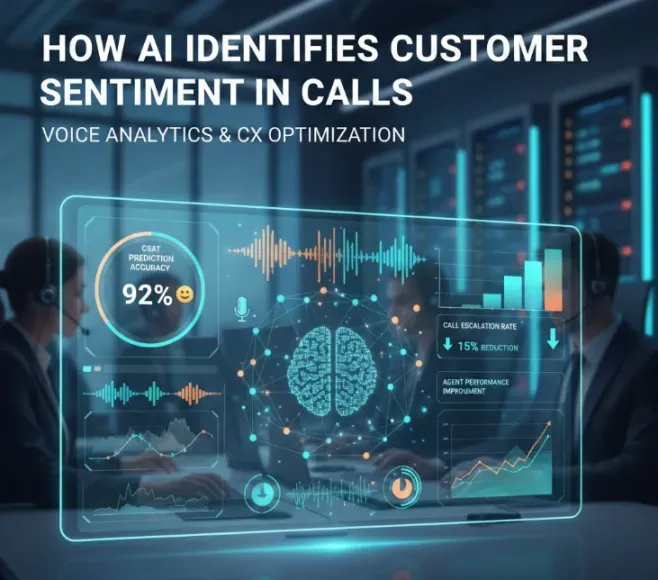
CSAT Prediction Accuracy: Correlation between AI sentiment scores and actual survey results.
Call Escalation Rate: How sentiment insights reduce unnecessary escalations.
Agent Performance Improvement: Impact of coaching guided by sentiment analytics.
Real-Time Feedback Uptake: Adoption rate of agent suggestions based on sentiment AI.
Best Practices Before Scaling
Ensure high-quality audio capture and consistent recording standards.
Standardize call labeling and metadata to enhance model accuracy.
Start with a pilot program focusing on one product line or region.
Combine automated sentiment insights with human review for nuanced understanding.
Use sentiment AI outputs to inform agent coaching sessions, not just dashboards.
Real Example: What to Avoid
A mid-sized contact center deployed sentiment AI without integrating CRM data. Initial insights were misleading, showing high satisfaction during long calls where customers were actually frustrated. Integrating historical purchase and service data corrected the model’s predictions and improved actionable accuracy.
Quick Wins Checklist
Action Expected Outcome Aggregate 6 months of call recordings Provides sufficient training data Tag calls with context and outcomes Improves sentiment scoring accuracy Run pilot program with 10 agents Identifies implementation gaps early Conduct weekly review of sentiment scores Aligns AI insights with coaching programs Integrate with CRM & CSAT surveys Enhances predictive accuracy
FAQ
Q1: What is an AI readiness assessment and why does it matter?
A1: It evaluates if your data, infrastructure, and processes can support AI deployments. It helps prioritize initiatives and avoid wasted investment.
Q2: How can I cut operational costs before scaling AI?
A2: Optimize agent workflows, standardize processes, and pilot AI on limited datasets before full deployment. Download our cost-cutting toolkit for actionable steps.
Q3: What are the biggest blockers to digital transformation in enterprise?
A3: Data silos, lack of leadership alignment, and insufficient skills. Addressing these early ensures AI projects deliver value.
Q4: How do I future-proof my operations for the next 5 years?
A4: Adopt scalable AI platforms, continuously train models with new data, and integrate human oversight for ethical and accurate insights.
Q5: When should I use a tool like GetFutureProof.ai vs building in-house?
A5: Use GetFutureProof.ai for rapid assessment, benchmarking, and guided frameworks. In-house development makes sense if you have mature data pipelines and AI expertise.
Conclusion
Ready to uncover customer sentiment and optimize call center operations with AI? Explore GetFutureProof.ai’s assessment tools to evaluate your organization’s AI readiness and build a future-proof transformation plan.


